Family emergency plan: simple steps and a template
Updated October 18, 2026 · Based on Ready.gov and other public guidance
A family emergency plan is a short written agreement about what your household will do if something unexpected happens: how you will get alerts, where you will meet, who everyone will contact, how you will leave and what you will take. Ready.gov breaks it into four steps: talk it through together, plan for your household's needs, write it down, and practice it.
Four steps to a family emergency plan
- Talk it through. Sit down with everyone in the home. Ready.gov suggests five questions: How will we receive alerts and warnings? What is our shelter plan? What is our evacuation route? What is our communication plan? Do we need to update our emergency kit?
- Plan for your household. Look at what your family needs day to day (see the list below).
- Write it down. One or two pages, in plain words, kept where everyone can find them.
- Practice it. A plan everyone has walked through once is far easier to follow.
Plan for each person
Ready.gov lists the needs to think through. Tick the ones that apply to your home:
- Ages of everyone in the home
- Who helps whom
- Places you visit often (school, work, care)
- Dietary needs
- Medical needs, prescriptions and equipment
- Disabilities, devices and access needs
- Languages spoken
- Cultural and religious considerations
- Pets or service animals
- School-age children
A family emergency plan template
Copy these headings onto one page and fill them in together:
| Household | Names, birthdays, medical notes, medicines |
| Alerts | How each adult gets local alerts |
| Out-of-area contact | One person everyone calls or texts to check in |
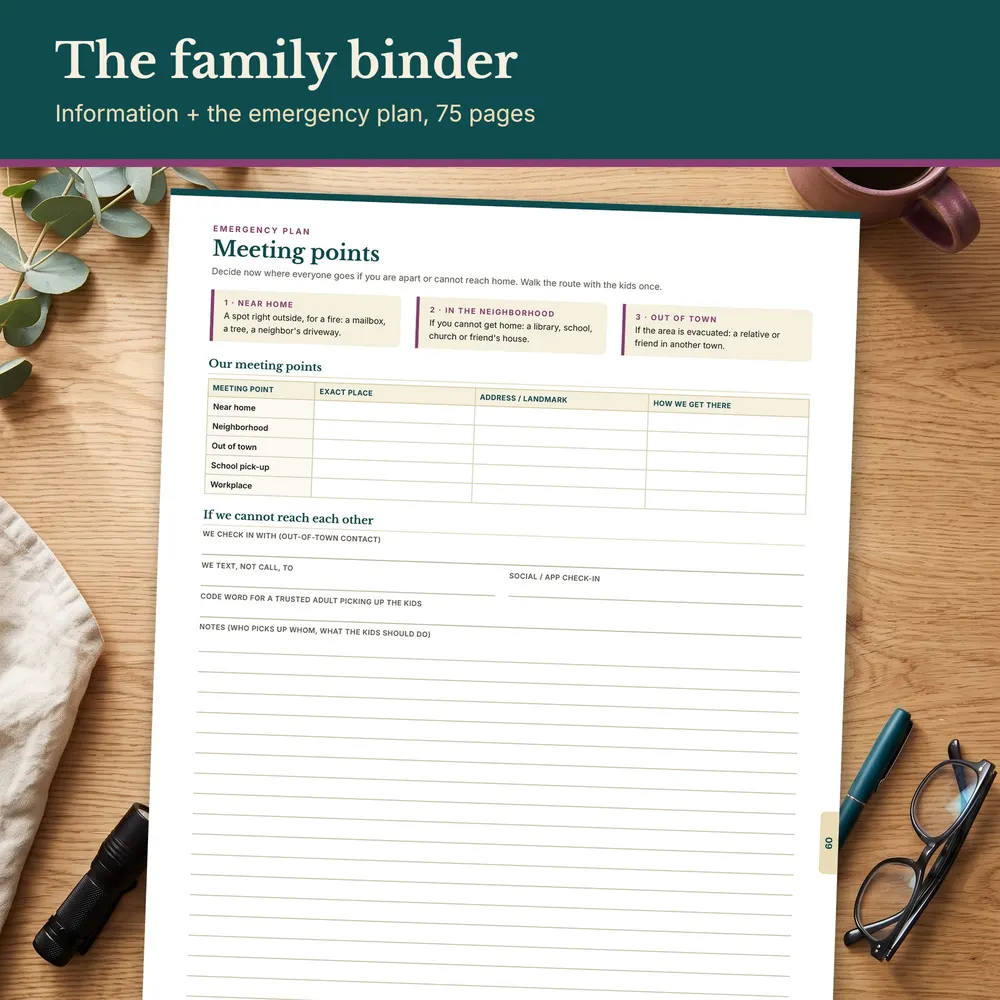
| Meeting place 1 | Right outside the home |
| Meeting place 2 | Outside the neighborhood (a library, a friend's house) |
| Meeting place 3 | Out of town |
| Routes | Two ways out, and destinations in different directions |
| School and work | Pick-up plan and who does it |
| Shelter in place | Which room, and where the supplies are |
| Go bags | Where they are and who is responsible for each |
| Utilities | Where the shut-offs are |
| Pets | A pet-friendly place to stay |
A few details from Ready.gov's evacuation guidance are worth adding: know alternate routes out of your area, keep the car's tank at least half full, and plan for pets ahead of time, since most public shelters allow only service animals. If time allows when you leave, tell your out-of-area contact where you are going.
Make the communication plan easy to carry
Phones run out of battery, and few people remember numbers by heart. Write the out-of-area contact and the meeting places on a small card for every wallet, backpack and car. Kids can keep theirs in their school bag.
Practice it, the easy way
Ready.gov's last step is simple: practice your plan with your household. Walk to meeting place 1. Drive route 2 on a weekend. Time how long it takes to grab the go bags. Make it a game, keep it short, and finish with something nice. Twice a year, along with a go bag refresh, is a rhythm many families keep.
Keep the plan with everything else
The plan works best next to the information it relies on: contacts, medical pages and document copies. That is exactly what an emergency binder is for. For outages, add the steps from the power outage checklist.
Questions families ask
What should a family emergency plan include?
How you will get alerts, an out-of-area contact, meeting places near home, outside the neighborhood and out of town, evacuation routes, school and work plans, a shelter-in-place spot, where the go bags are, utility shut-offs and a plan for pets.
How do I create a family emergency plan?
Ready.gov describes four steps: talk it through with your household, plan for each person's needs, write the plan down, and practice it together.
How often should we practice our family emergency plan?
Ready.gov advises practicing the plan with your household. Many families do a short drill twice a year, at the same time they refresh their go bags.
What is an out-of-area contact?
A relative or friend who lives elsewhere and whom everyone in the family calls or texts to check in, so you can pass messages even if you cannot reach each other directly.
Where should we keep our family emergency plan?
Keep the written plan in your emergency binder, put a copy in each go bag, and give everyone a wallet card with the contact and meeting places.
Do pets need to be in the family emergency plan?
Yes. Ready.gov notes that most public shelters allow only service animals, so plan a pet-friendly place to stay and pack pet supplies in advance.
This guide is general information to help you get organized. It is not medical, legal or financial advice. In an emergency, call 911 and follow the instructions of local officials.
Sources (opened October 18, 2026):